
Big Data Analytics
What is Big Data Analytics ?
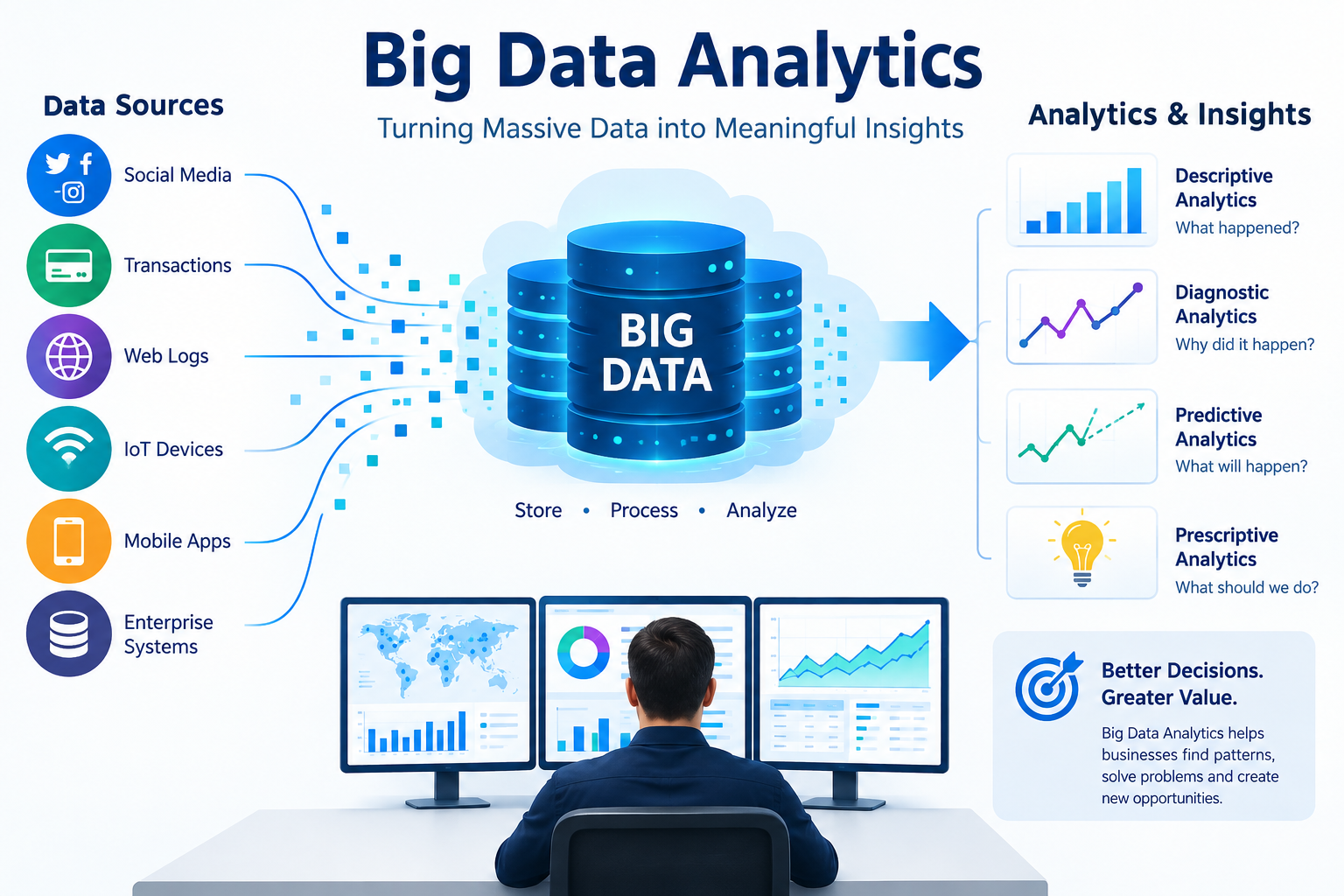
Big Data Analytics is the process of collecting, processing, and analysing very large and complex amounts of data using advanced techniques and technologies to analyze huge amounts of data to discover useful patterns, trends, and insights.
By analyzing this data, the company can understand what customers want, predict future buying behavior, and recommend suitable products.
Main types of Big Data Analytics
- Descriptive Analytics – What happened?
- Diagnostic Analytics – Why did it happen?
- Predictive Analytics – What will happen?
- Prescriptive Analytics – What should we do?
Tools Used in Big Data Analytics
| Apache Hadoop | Distributed storage and processing of large datasets |
| Apache Spark | Fast, large-scale data processing and analytics |
| Apache Kafka | Real-time data streaming and processing |
| Apache Hive | SQL-based analysis of large datasets |
| Apache HBase | NoSQL database for large-scale data |
| Python | Data analysis, machine learning, and visualization |
| R | Statistical analysis and data visualization |
| Tableau | Data visualization and interactive dashboards |
| Power BI | Business intelligence and reporting |
| MongoDB | NoSQL database for storing unstructured/semi-structured data |
| Elasticsearch | Searching and analyzing large volumes of data |
Popular Big Data stack
Data Sources → Kafka → Hadoop/Spark → Hive → Python/R → Tableau/Power BI
For a college assignment or presentation, the most important tools to mention are Hadoop, Spark, Kafka, Hive, Python, R, Tableau, and Power BI.