
Data Analytics
An Information Technology (IT) Consultant is a professional who helps organizations use technology to solve business problems, improve efficiency, reduce costs, and achieve their goals. Rather than building one product full-time, consultants typically advise clients, design solutions, and oversee technology implementations.
- Analyze a company's current IT systems and business processes.
- Identify technology-related problems and recommend solutions.
- Design and plan IT infrastructure, software, or cloud solutions.
- Manage technology implementation projects.
- Advise on cybersecurity, data protection, and compliance.
- Train employees on new technologies and systems.
- Monitor system performance and recommend improvements.
Consultant Details
Name : Sankar
Level : Expertise
Type : Individual Consultant / Freelancer
Service Content
Introduction
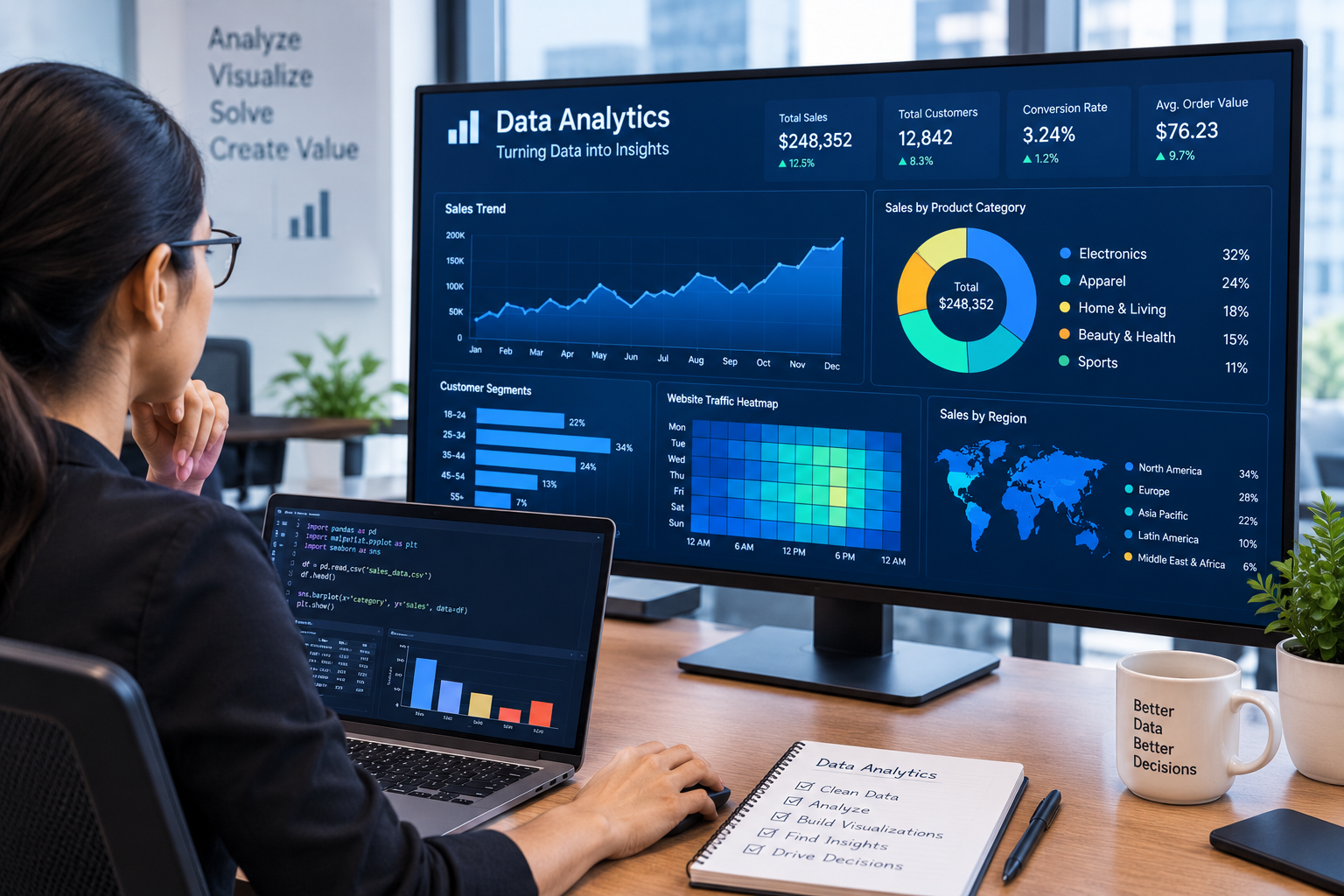
Data Analytics is the process of collecting, cleaning, transforming, and analyzing data to discover useful information, identify patterns, and support better decision-making.
What does a Data Analyst do?
A Data Analyst typically:
- Collects data from databases, spreadsheets, APIs, and other sources
- Cleans and prepares raw data
- Analyzes trends and patterns
- Creates reports and dashboards
- Uses statistics to understand data
- Communicates findings to business or technical teams
- Helps organizations make data-driven decisions
Responsibility
Taking full responsibilities in Data Analytics Life Cycle through feasibility study, Business case, Initiation, Planning process to finalizing the baseline of Scope, Schedule and cost, Resource Allocation & Scheduling, involved all kind of Quality Management, assurance and control, Procurement Management, Risk Management, risk response strategy and Execution, Monitor/control process Control Planning/Monitoring, and Stakeholder management etc.
Proficient in Solution Implementation Cycle involving Business Requirement Study & Problem Identification (AS IS), Technology Research for Product/Service selection as Solution Design (TO BE); Stake Holder Coordination for Acceptance of Solution; Risk Identification & Mitigation; Change/Configuration Management & Solution Implementation; CT, CIT, SAT, UAT, Training & Support.
Competent in all phases of Software Development Life Cycle including Analysis & Study of Business Requirements, Technical & Functional Specifications, Data/Interface/Process Design, Module/Interface Development, Testing, Integration, Implementation along with Service Support.
Team Management & Human Resource Management through consensus building, promotion of positive environment, & teamwork spirit, competence development, providing vision & efficiency, issue resolution, motivation and mentoring.
Cohesive Team Player with Fast Learning Curve along with strong analytical, problem-solving, innovation, planning, organizational, communication & interpersonal skills
Timely prepare, evaluate and publish all KPI’s and use MIS to communicating all kinds of reports like status, progress, forecast, etc.
Client Acceptence / signoff
We will get approval for all the documents either before start or after finishing from the respective stakeholders.
So that, we could have avoided any mess in the project.
Client signoff
Clients may be asked to sign documents such as:
- Business Requirements Document (BRD)
- Functional Requirements Specification (FRS)
- Solution Design Document (SDD)
- Test Plan and Test Results
- UAT Completion Report
- Deployment Checklist
- Go-Live Approval Form
- Project Closure Report
- Knowledge Transfer and Handover Document
Current Challenges
Poor data quality – Missing, duplicate, outdated, or incorrect data can lead to inaccurate analysis.
Large volumes of data – Organizations generate huge amounts of data, making storage, processing, and analysis more difficult.
Data integration – Combining data from different databases, applications, spreadsheets, and cloud platforms can be complicated.
Data privacy and security – Protecting personal and sensitive information while using it for analysis is a major responsibility.
Rapidly changing technology – Analysts need to continuously learn new tools, AI technologies, cloud platforms, and analytical techniques.
AI and automation – AI can automate many analytical tasks, requiring analysts to focus more on business understanding, critical thinking, validation, and communication.
Real-time analytics – Businesses increasingly expect insights from continuously changing data rather than waiting for periodic reports.
Difficulty communicating insights – A technically correct analysis may not be useful if the findings cannot be explained clearly to non-technical stakeholders.
Data silos – Important information may be stored separately across departments, making it difficult to obtain a complete picture.
Bias in data and analysis – Historical or incomplete data can produce misleading results if analysts do not carefully examine the data and methodology.